
A query in one round trip
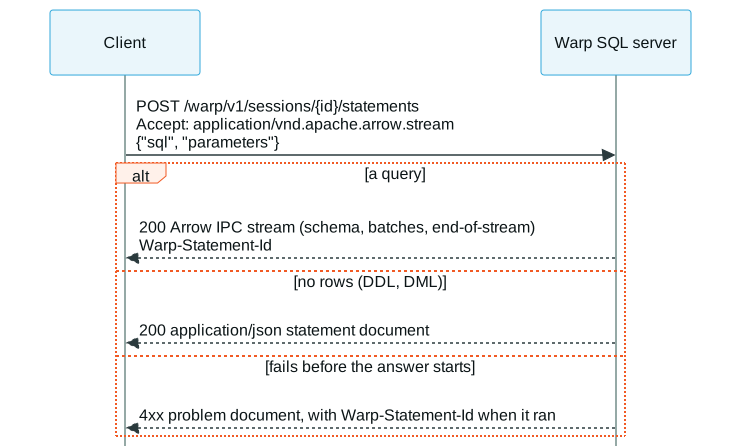
Short queries stay short: one request runs the statement and streams its result
(§6.1). The client asks for it with Accept: application/vnd.apache.arrow.stream
and no Prefer: respond-async.
WARP=http://127.0.0.1:31337TOKEN=$(curl -s $WARP/warp/v1/auth/token -H 'Content-Type: application/json' \ -d '{"grant_type": "password", "username": "joe", "password": "s3:cret"}' | jq -r .access_token)AUTH="Authorization: Bearer $TOKEN"SESSION=$(curl -s $WARP/warp/v1/sessions -H "$AUTH" -H 'Content-Type: application/json' -d '{}' | jq -r .session_id)Run a query
Section titled “Run a query”curl -s -D headers.txt $WARP/warp/v1/sessions/$SESSION/statements -H "$AUTH" \ -H 'Content-Type: application/json' -H 'Accept: application/vnd.apache.arrow.stream' \ -d '{"sql": "SELECT i, i * i AS square FROM range(5) t(i)"}' -o result.arrowstr -d '\r' < headers.txt | grep -E '^(HTTP|Content-Type|Warp-Statement-Id|Warp-IPC-Compression|Cache-Control)'python3 -c "import pyarrow.ipc as ipc; print(ipc.open_stream('result.arrows').read_all().to_pylist())"HTTP/1.1 200 OKWarp-Statement-Id: q_…Warp-IPC-Compression: noneCache-Control: no-storeContent-Type: application/vnd.apache.arrow.stream[{'i': 0, 'square': 0}, {'i': 1, 'square': 1}, {'i': 2, 'square': 4}, {'i': 3, 'square': 9}, {'i': 4, 'square': 16}]The body is one complete Arrow IPC stream: the schema, the record batches and the end-of-stream marker (§2.2). The server sends the schema as soon as it knows it, so a query whose first rows come late (an aggregate) doesn’t sit silent until a proxy cuts it.
Bind parameters
Section titled “Bind parameters”parameters holds values, never SQL text: an array binds positionally (?), an object by name
($name). The server binds them through the engine’s parameter mechanism and never splices
them into the statement. Values are JSON scalars; for exact types (decimals, timestamps, binary,
nested values) use a prepared statement with Arrow parameters:
curl -s $WARP/warp/v1/sessions/$SESSION/statements -H "$AUTH" \ -H 'Content-Type: application/json' -H 'Accept: application/vnd.apache.arrow.stream' \ -d '{"sql": "SELECT $city AS city, $year + 1 AS next_year", "parameters": {"city": "Oslo", "year": 2026}}' \ -o named.arrowspython3 -c "import pyarrow.ipc as ipc; print(ipc.open_stream('named.arrows').read_all().to_pylist())"[{'city': 'Oslo', 'next_year': 2027}]Statements without rows
Section titled “Statements without rows”DDL and DML answer 200 with a JSON statement document instead of an Arrow stream, so a
client must check Content-Type:
curl -s $WARP/warp/v1/sessions/$SESSION/statements -H "$AUTH" -H 'Content-Type: application/json' \ -d '{"sql": "CREATE TABLE cities (id INTEGER, name VARCHAR)"}' > /dev/nullcurl -s -D headers.txt $WARP/warp/v1/sessions/$SESSION/statements -H "$AUTH" \ -H 'Content-Type: application/json' -H 'Accept: application/vnd.apache.arrow.stream' \ -d '{"sql": "INSERT INTO cities VALUES (1, ?), (2, ?)", "parameters": ["Oslo", "Lima"]}' -o bodytr -d '\r' < headers.txt | grep -E '^(HTTP|Content-Type)'jq -c '{state, result}' bodyHTTP/1.1 200 OKContent-Type: application/json{"state":"succeeded","result":{"kind":"update","rows_affected":2}}Errors before the answer
Section titled “Errors before the answer”An error found before execution starts (a syntax error, a permission denial), or a statement
that has already failed by the time the server answers, is an error response: a problem
document with a stable code, and Warp-Statement-Id when the statement ran (§11):
curl -s $WARP/warp/v1/sessions/$SESSION/statements -H "$AUTH" \ -H 'Content-Type: application/json' -H 'Accept: application/vnd.apache.arrow.stream' \ -d '{"sql": "SELEC 1"}' | jq '{type, status, code}'{ "type": "urn:warp-sql:error:sql_error", "status": 400, "code": "sql_error"}A failure after the stream has started can’t change the status any more: see Errors mid-stream.
Compression
Section titled “Compression”Warp-IPC-Compression lists the Arrow buffer codecs the client accepts, in its order of
preference (§8.2). The server uses the first it supports and says which in the
response’s header of the same name. lz4_frame costs little CPU; zstd compresses more:
curl -s -D zheaders.txt $WARP/warp/v1/sessions/$SESSION/statements -H "$AUTH" \ -H 'Content-Type: application/json' -H 'Accept: application/vnd.apache.arrow.stream' \ -H 'Warp-IPC-Compression: zstd, lz4_frame' \ -d '{"sql": "SELECT i % 7 AS v FROM range(1000000) t(i)"}' -o packed.arrowstr -d '\r' < zheaders.txt | grep '^Warp-IPC-Compression'python3 -c "import pyarrow.ipc as ipc; print(ipc.open_stream('packed.arrows').read_all().num_rows)"Warp-IPC-Compression: zstd1000000HTTP content coding (Accept-Encoding) is a separate, independent layer.
 Warp SQL is an open protocol, Apache 2.0 licensed. It is maintained by GizmoData.