
Partitioned results
One TCP connection carries what one network flow allows. A client that reads a large result over
several connections at once can go faster, past what one stream can carry (capability
result_partitions, §6.10). Warp SQL’s drivers ask for 8 partitions by default.
| Request header | Meaning |
|---|---|
Warp-Result-Partitions: <n> |
The client reads up to n partitions at once (1 to 256) |
Warp-Result-Order: preserve or any |
any: the client doesn’t need rows in result order (default preserve) |
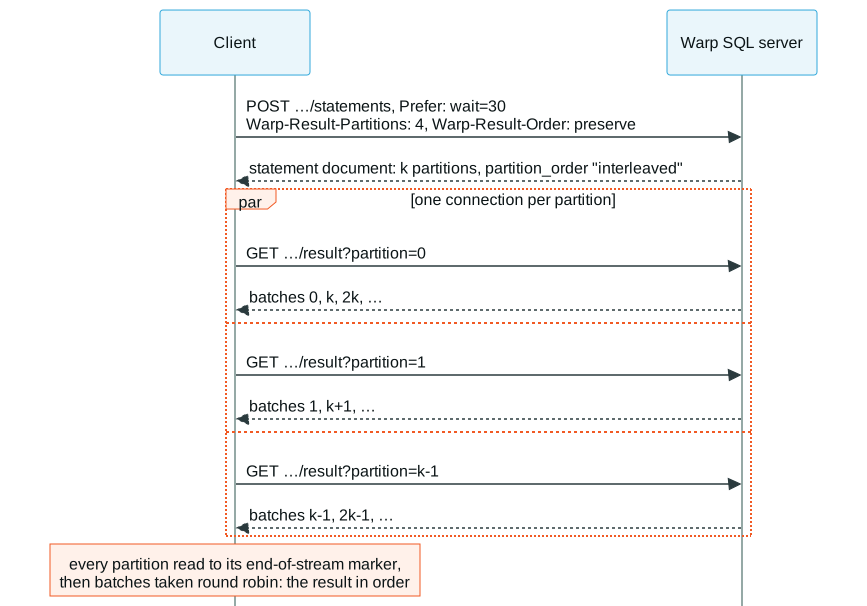
The server splits the result into k partitions, 1 ≤ k ≤ n, by its size: a result of a
few batches stays in one. With preserve the batches are dealt round robin (interleaved):
batch j of the result is batch j div k of partition j mod k. With any each batch is in
exactly one partition and order means nothing.
WARP=http://127.0.0.1:31337TOKEN=$(curl -s $WARP/warp/v1/auth/token -H 'Content-Type: application/json' \ -d '{"grant_type": "password", "username": "joe", "password": "s3:cret"}' | jq -r .access_token)AUTH="Authorization: Bearer $TOKEN"SESSION=$(curl -s $WARP/warp/v1/sessions -H "$AUTH" -H 'Content-Type: application/json' -d '{}' | jq -r .session_id)Ask for partitions
Section titled “Ask for partitions”STATEMENT=$(curl -s $WARP/warp/v1/sessions/$SESSION/statements -H "$AUTH" -H 'Content-Type: application/json' \ -H 'Prefer: wait=60' -H 'Warp-Result-Partitions: 4' -H 'Warp-Result-Order: preserve' \ -H 'Warp-Retain-Result: true' \ -d '{"sql": "SELECT i, i * 2 AS twice FROM range(10000000) t(i) ORDER BY i"}' \ | tee doc.json | jq -r .statement_id)jq -c '{state, partition_order: .result.partition_order, partitions: (.result.partitions | length)}' doc.json{"state":"succeeded","partition_order":"interleaved","partitions":4}Read every partition at once
Section titled “Read every partition at once”Each partition is an Arrow stream with the result’s schema, read on its own connection with
?partition=<i>. A client must read all of them concurrently, and each to its
end-of-stream marker: the server produces an unretained result only as fast as its slowest
partition is read, so reading one to its end before starting the next can stall the statement.
for i in 0 1 2 3; do curl -s "$WARP/warp/v1/sessions/$SESSION/statements/$STATEMENT/result?partition=$i" \ -H "$AUTH" -o part$i.arrows &donewaitPutting the result back in order means taking the next batch of partition 0, then of partition 1, and so on round robin, until a partition has no next batch:
python3 - <<'EOF'import itertoolsimport pyarrow as paimport pyarrow.ipc as ipc
partitions = [list(ipc.open_stream(f"part{i}.arrows")) for i in range(4)]print("batches per partition:", [len(p) for p in partitions])ordered = [b for round_ in itertools.zip_longest(*partitions) for b in round_ if b is not None]column = pa.Table.from_batches(ordered).column("i")print(column.length(), "rows, in order:", column.equals(pa.chunked_array([pa.array(range(10_000_000))])))EOF
batches per partition: […]10000000 rows, in order: TrueEvery partition has as many batches as partition 0 or one fewer, and none has an empty batch.
On the streamed path
Section titled “On the streamed path”A streamed submit (Accept: application/vnd.apache.arrow.stream) that asks for partitions gets
partition 0 in the response body. When the result has more than one partition, the response
carries Warp-Result-Partitions: <k> and Warp-Result-Order: interleaved or any, and the
client opens ?partition=1 to k - 1 at once, using the statement id from
Warp-Statement-Id. With one partition it carries neither header; a client never guesses a
missing Warp-Result-Order.
A server without the capability ignores both request headers and returns one partition, so a
client always checks how many partitions it got. Retention and resumption apply to each
partition on its own, and cancel and DELETE act on the whole statement.
Partitions on other servers
Section titled “Partitions on other servers”With capability result_locations, a client that sends Warp-Result-Locations: remote may get
partitions whose location is another server’s base URL: a distributed engine can hand out
partitions held where they were computed, with no change to the protocol (§6.2). A
client that doesn’t send the header never sees one.
 Warp SQL is an open protocol, Apache 2.0 licensed. It is maintained by GizmoData.