
Plain HTTP
Every operation works over HTTP/1.1 through an ordinary reverse proxy. Nothing relies on HTTP/2 streams, trailers or server push, and no request has to outlive a proxy timeout.
Run SQL from anything that speaks HTTP. Get Arrow back.
Warp SQL is an open protocol for running SQL against a database server over plain HTTP.
Query results, query parameters and bulk uploads travel as
Apache Arrow IPC streams
(application/vnd.apache.arrow.stream), so every Arrow library reads them directly. Control
messages are small JSON documents. A browser fetch, curl or any language’s standard HTTP
library is a complete client: there is no gRPC, no protobuf and no generated code.
It does for HTTP what Arrow Flight SQL does for gRPC: a small set of operations that any engine can implement and any HTTP client can call. Its metadata endpoints return Flight SQL’s result schemas, so driver code written for Flight SQL carries over.
Version 1, specification 1.0.1. Version 1 is stable: it changes only by addition (new endpoints, fields, capabilities and error codes), so a client written for 1.0.0 keeps working with every later 1.x server. See Versioning and compatibility.
Plain HTTP
Every operation works over HTTP/1.1 through an ordinary reverse proxy. Nothing relies on HTTP/2 streams, trailers or server push, and no request has to outlive a proxy timeout.
Arrow all the way
Results, Arrow query parameters and uploads are Arrow IPC streams, with optional lz4_frame
or zstd buffer compression. No row-by-row conversion on either side.
Short queries stay short
One POST runs a query and streams its result. Long queries are submitted, long-polled
and fetched later, and a dropped download resumes from the batch where it stopped.
Wide when it pays
A large result can be read as several partitions over separate connections at once, in order when the query has one. A large upload can be sent as several parts and committed as one transaction.
Security in the core
Credentials are bearer tokens, never cookies, so cross-site request forgery is impossible by construction. Every handle is bound to the identity that created it and checked on every use. Mutual TLS and browser sign-in are in the protocol.
Engine-neutral and open
Apache 2.0 licensed. Nothing in the protocol depends on one engine, and a black-box conformance suite tells an implementation when it is done.
Sign in, open a session, run a query and read the Arrow result. These commands run against
warp-duckdb, the reference server, listening on 127.0.0.1:31337 with user joe:
WARP=http://127.0.0.1:31337TOKEN=$(curl -s $WARP/warp/v1/auth/token -H 'Content-Type: application/json' \ -d '{"grant_type": "password", "username": "joe", "password": "s3:cret"}' | jq -r .access_token)SESSION=$(curl -s $WARP/warp/v1/sessions -H "Authorization: Bearer $TOKEN" \ -H 'Content-Type: application/json' -d '{}' | jq -r .session_id)curl -s $WARP/warp/v1/sessions/$SESSION/statements -H "Authorization: Bearer $TOKEN" \ -H 'Content-Type: application/json' -H 'Accept: application/vnd.apache.arrow.stream' \ -d '{"sql": "SELECT 42 AS answer, ? AS greeting", "parameters": ["hello"]}' -o result.arrowspython3 -c "import pyarrow.ipc as ipc; print(ipc.open_stream('result.arrows').read_all().to_pylist())"[{'answer': 42, 'greeting': 'hello'}]Every server describes itself at GET /warp (no credentials needed), so a client knows which
optional features it may use:
curl -s http://127.0.0.1:31337/warp | jq .{ "protocol": "warp-sql", "protocol_versions": [ "1" ], "server": { "name": "warp-duckdb", "version": "1.0.1 (DuckDB …)" }, "capabilities": [ "prepared_statements", "transactions", "ingest", "partitioned_ingest", "long_poll", "ipc_compression_zstd", "ipc_compression_lz4_frame", "result_partitions", "openapi" ], "auth": { "grant_types": [ "password" ] }, "links": { "openapi": "/warp/v1/openapi.json" }}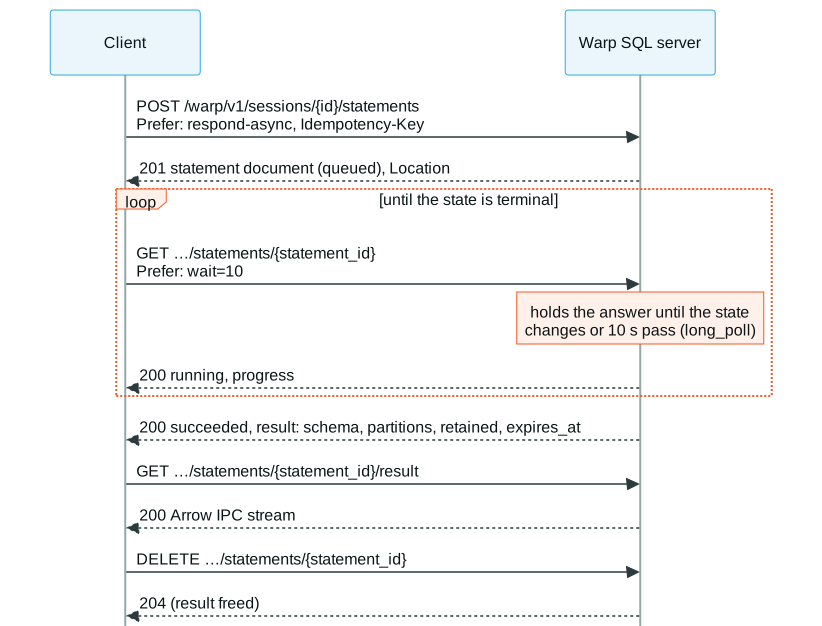
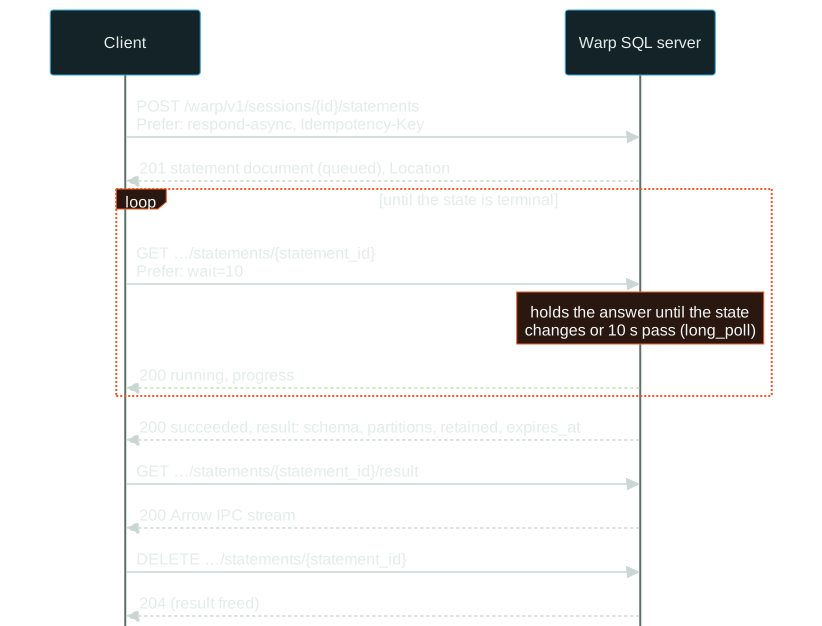
The flows walk through every operation with a sequence diagram and commands you can run.
 Warp SQL is an open protocol, Apache 2.0 licensed. It is maintained by GizmoData.